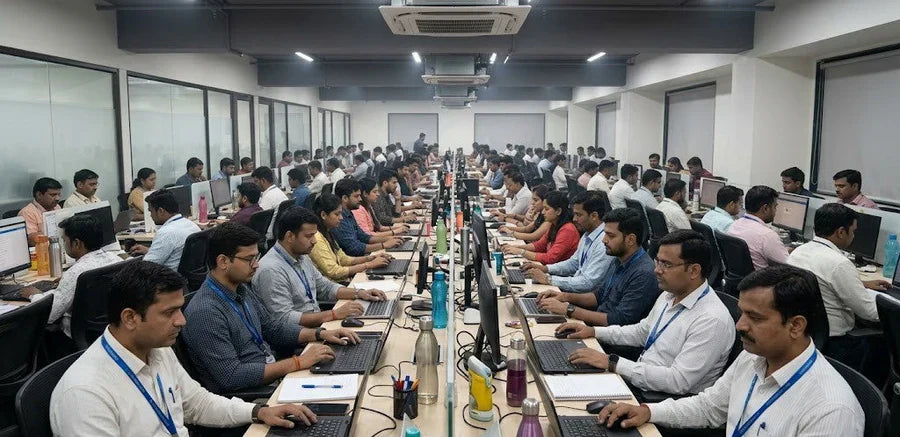
Open plan floors carry more pollution sources, worse air distribution, and zero personal ventilation control compared to private offices. A shared unit sitting in the corner improves the room's average air quality — but contributes nothing to your immediate breathing zone. In high-density open layouts, the only protection that actually works is one operating at the personal level.
What makes open offices particularly damaging to air quality:
- No partitions mean pollutants originating anywhere on the floor eventually reach every desk
- Higher headcount accelerates CO₂ buildup and raises airborne particle concentration per cubic metre
- HVAC airflow patterns in open layouts frequently produce dead zones where air stagnates rather than circulates
- Printer stations, kitchen areas, and busy walkways all share air directly with your workstation
You cannot redesign the floor. You can take control of what enters your lungs within it. Here is what actually helps.
Why Does Air Quality in an Open Plan Office Deteriorate So Much Faster Than in a Private Cabin?
The underlying physics is not complicated. In an open plan office, there is nothing to contain pollution — so everyone on the floor is sharing all of it, continuously.
In a private cabin with one or two people, CO₂ accumulates slowly, contamination sources stay limited, and any air purification present is handling a manageable volume. On an open floor with 40 people, CO₂ from all 40 accumulates at once. Particles from clothing, exhaled aerosols, VOCs from workstation equipment, the smell of someone's lunch across the room — all of it moves freely with nothing to interrupt the flow.
HVAC systems in open plan buildings also distribute air less evenly than most people assume. Vents are placed for thermal comfort, not contamination management. The result is that certain areas receive strong airflow while others sit in relative dead zones where particles settle and build up. Whether your desk lands in a well-ventilated zone or a stagnant one is essentially down to chance.
Can a Single Shared Office Air Purifier Protect Every Person Equally Across a Large Open Floor?
No — and this distinction matters before committing to a solution.
A shared office air purifier raises the average air quality of the room it occupies. That sounds valuable until you think carefully about what average means in practice. The unit draws in air, processes it, and releases cleaner air back into the space. That cleaner air then travels the full length of the floor, picking up particles from every surface, person, and source it encounters along the way. By the time it reaches your breathing zone, it has passed through the entire room. The further your desk sits from the unit, the smaller the benefit — and across a large open floor, that distance can be considerable.
Room-level purification in an open layout shifts averages. It does not protect individual people.

What Makes a Personal Air Purifier Wearable the Most Practical Choice for High-Density Open Offices?
The case for a personal air purifier wearable in an open office comes down to one straightforward point. When exposure sources are distributed across the entire floor, protection needs to stay anchored to you — not to a fixed point in the room.
A device worn on the body treats the air directly around your face, independent of whatever the HVAC is doing at the other end of the floor. And because a typical workday takes you through multiple zones — desk, meeting room, kitchen, corridor — a wearable maintains coverage across all of them, where any fixed unit covers none of them.

How Does a Wearable Air Purifier Create a Private Clean-Air Zone When You Are Seated Next to 50 Colleagues?
Wearable air purifiers that use anion-based technology emit negatively charged ions into the air directly surrounding the device. Those ions attach to particles — PM2.5, bacteria, allergens, VOCs — causing them to bond together, gain weight, and fall below your breathing level before you inhale them. The mechanism is straightforward, but the effect is real.
The zone it creates is personal. Not the floor, not your whole desk — just the immediate space in front of your face where your breathing actually happens. That precision is the entire point.
In a dense open layout that personal zone carries more weight, not less. Your neighbour is exhaling. Equipment around you is releasing VOCs. Foot traffic on the floor continuously disturbs settled particles. A room unit somewhere behind you is not treating any of that at your specific breathing level. A wearable is.

Is an Air Purifier Necklace Genuinely Effective in an Open Office or Just a Wellness Trend With No Substance?
A fair question, and one that deserves a direct answer. An air purifier necklace delivers real protection when the core technology is sound and the anion output is sufficient to meaningfully treat the immediate breathing zone.
Healthy scepticism about this category is warranted. Many products make performance claims without independent data to back them up. What you need before purchasing any wearable purifier is third-party laboratory testing — conducted at a recognised facility — showing actual pollutant reduction figures under controlled conditions. Marketing language is not a substitute for test results.
For devices that carry that validation, yes — the air purifier necklace format provides genuine personal zone protection in open office environments. The format also suits the setting naturally. It is unobtrusive, produces no noise, and needs nothing from the space itself — no power outlet, no fixed position, no coordination with facilities management.
What it does not do is clean the whole floor. That is not its purpose. What independent testing supports is a meaningful reduction in what you personally breathe across the working day — and that is the outcome worth targeting.
How Does a Neck Air Purifier Help Maintain Your Personal Air Quality Through a Full Day of Desk Work and Meetings?
The key advantage a neck air purifier holds over a desk unit in an open office is uninterrupted coverage. A desk unit protects you while you are seated at it. The moment you stand up — to take a meeting, walk to the kitchen, take a call in the corridor — the protection stops entirely.
A neck unit keeps your personal zone intact across every environment you pass through during a workday: desk, meeting room, shared lounge, commute home. Protection is consistent because it moves with you rather than staying fixed to a location. Battery endurance becomes especially relevant here — for full open-office days, prioritise devices rated at 40 or more hours per charge.
What Should You Look for in an Air Purifier for the Office That Is Designed for Open, Shared Layouts?
For an open-plan environment, an air purifier for the office needs to operate at the personal zone level rather than room scale. It should run silently enough that it never becomes a distraction or gets switched off. It should be wearable or positioned close to the desk. It must carry independently verified test results from a credible facility. And it should be filter-free — because replacing filters in a shared office setting is inconvenient enough that most people eventually stop doing it, which defeats the purpose entirely.
RAIRE Pebble: The Personal Air Purifier Built for Open-Office Protection That Never Disrupts the Team
The RAIRE Pebble was designed around exactly the requirements described above. It is a personal air purifier worn around the neck — 50 grams, completely silent, filter-free, with 40-plus hours of runtime on a single charge.
No power outlet at your desk. No noise. No visibility to the people around you.
Does it fix the open office's ventilation problem? No — that is a structural issue. What it does is measurably reduce what you personally inhale across the working day, which is a distinct and far more tractable problem to solve.
For a closer look at how personal purifiers perform under independent testing, Do Wearable Air Purifiers Actually Work covers the science in detail. And for environments where the open layout challenge is compounded by shifting occupancy, Co-working Spaces and Air Quality addresses that scenario specifically.
Share:
Why Is Air Quality in Co-working Spaces So Hard to Control — and Where Does a Portable Air Purifier Fit In?
Does AC Purify Air? What Indoor Air Quality Monitor Data Actually Shows About Office Ventilation